Every Market Has a Financial Dialect: Why Payment Unfamiliarity Kills Global Conversion
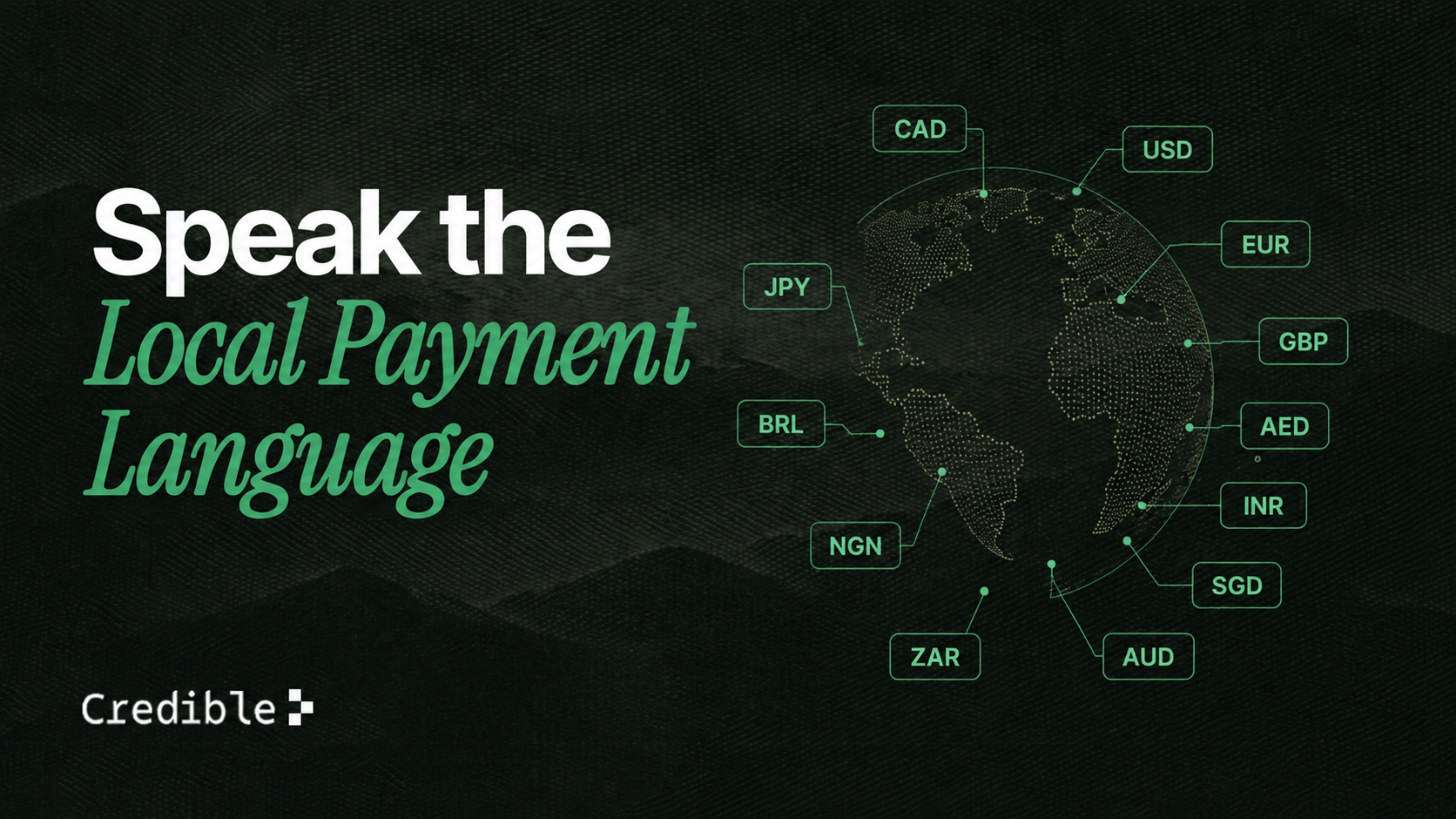
When a software business or digital enterprise decides to enter a new market, the playbook is deeply standardized.
The growth team hires native translators, localizes landing pages, adjusts pricing models for regional purchasing power, and runs geo-targeted ad campaigns. Every customer touchpoint is meticulously tuned to sound, look, and feel native.
And then, at the final step of the funnel. The exact moment a user decides to hand over money. The experience fractures.
The checkout form asks for a 16-digit credit card number, charges an unannounced foreign exchange fee, or redirects to an unfamiliar third-party gateway.
It is the equivalent of fluent marketing delivered in a language the buyer doesn't speak at checkout.
Every market has a native language for money. If your infrastructure doesn't speak it, your international expansion is operating with an invisible tax on conversion.
The Conversion Gap: What the Data Shows
Treating local payment rails as a "nice-to-have" feature rather than core infrastructure ignores a massive body of empirical e-commerce data.
Comprehensive research from Paddle analyzed global checkout behavior across thousands of SaaS and digital commerce platforms. The findings highlight a clear divide between localized and unlocalized checkouts:
  [Standard Checkout] ──> 4.3% Conversion (Global Plastic Cards Only)
                                 │
  [Localized Stack] ──> 6.5% Conversion (+51% Relative Lift via Local Rails)
A jump from 4.3% to 6.5% isn't an incremental optimization. It is a fundamental shift in unit economics. It lowers customer acquisition costs (CAC), extends paid ad runway, and unlocks growth in regions previously deemed "unprofitable."
Why Familiarity Equals Velocity
Why does payment localization drive such dramatic conversion lifts?
It comes down to trust, friction, and regional banking infrastructure.
The Trust Barrier: When a buyer in Vietnam sees a VietQR code, or a buyer in Brazil sees a Pix interface, they recognize national, central-bank-backed infrastructure. When forced to enter credit card details into an offshore form, security anxiety peaks. Leading to cart abandonment.
Authorization Failure Rates: Cross-border credit card transactions carry notoriously poor authorization rates. Domestic issuing banks frequently flag international card charges as foreign fraud. Native payment methods like Indonesian Virtual Accounts or UK Faster Payments settle directly through local bank rails, pushing payment success rates near 100%.
The Credit Card Illusion: Western founders often assume credit cards are universal. In reality, credit card penetration across emerging markets remains low. Consumers and businesses rely on real-time bank transfers, local e-wallets, and camera-scanned QR systems.
If your product speaks the local language, but your payment flow doesn't, you aren't actually accessible in that market.
The Backend Architectural Trap
If localized payments are so undeniably effective, why hasn't every global company deployed them?
Because building and managing local payment integrations traditionally requires an engineering and operational nightmare:
Entity Sprawl: Setting up local corporate entities in 40+ countries to gain access to regional merchant acquirers.
Capital Inefficiency: Pre-funding bank accounts in every jurisdiction to manage local payouts and cover operational float.
Trapped Treasury (T+3 to T+7): Waiting days for local acquirers to clear funds into offshore parent accounts, while accumulating massive FX exposure in volatile currencies.
Legacy gateways solved the front-end problem by offering local drop-down options, but they passed the back-end settlement delays and high FX markups straight back to the merchant.
Enter Credible: Local Edges, Instant Core
This operational friction is why we built Credible's Open Payment Stack.
We believe that global commerce works best when payments feel 100% local to the person paying, but completely instant and unified for the business receiving the funds.
Through a single API integration, Credible connects 86+ local payment methods across 40+ markets directly into instant stablecoin liquidity:
Local at the Edges: Collect via VietQR (Vietnam), Virtual Accounts (Indonesia), PHP rails (Philippines), Pix (Brazil), SEPA (Europe), and ACH (US). Customers pay using the native rails they already use daily.
Instant T+0 at the Core: By utilizing automated AI risk scoring and programmatic on-chain float management, Credible advances liquidity instantly. Merchants don't wait out 3-day correspondent banking cycles proceeds settle immediately in USDC, USDT, or major fiat options.
  [Local Customer] ──> Pays via Native Local Rail (VietQR / Pix / VA / SEPA)
                                     │
                     [Credible Open Payment Stack]
                     • Real-Time AI Risk Scoring
                     • Asynchronous Fiat Clearing
                                     │
  [Global Merchant] <── Settles Instantly at T+0 (USDC / USDT / Fiat)
Over $1 Billion Processed
This architecture isn't theoretical. With over $1 Billion in cumulative payment volume routed through our infrastructure, Credible has proven that eliminating settlement friction and localizing rails changes transaction velocity forever.
Don't let your checkout form undo months of localization and marketing effort. Speak the native financial language of every market you enter and settle funds instantly on your own terms.
Join the Conversation
Stay updated with the latest in DeFi and crypto on our social channels.